
- Home
- About Us
- Connect
- Patient Resources
- Anesthesia / Sedation / Pain
- Patient Instructions/After Care
- Patient Intake Forms
- Patient Consent Forms
- Office Policies
- Insurance Plans
- Financial Policies
- Privacy Policy
- Online Privacy Policy
- Mobile Message Terms
- Statement of Nondiscrimination
- Open Payments Database Notice
- Accessibility Statement
- Pet/Service Animal Policy
- Health Advisory
- Medical Dermatology
- Mohs/Reconstructive Surgery
- Facial Aesthetics
- Facial Aging 101
- Concerns
- Non Surgical
- Surgical
- Hair Loss
- Cosmetic Mole Removal
- Body Aesthetics
- Varicose Veins
- Scars
- Skin Care
- Wound Care

Blistering Disorders
Blistering disorders are a group of skin conditions characterized by the formation of blisters, which are fluid-filled sacs that develop on the skin’s surface. These blisters can appear in response to a variety of causes, including autoimmune diseases, infections, allergic reactions, and genetic conditions. In autoimmune blistering disorders, the body’s immune system mistakenly attacks its own skin cells, leading to the formation of blisters. Some common examples include pemphigus vulgaris and bullous pemphigoid. Blistering can occur in localized areas or cover large portions of the skin, and the blisters may be painful or prone to rupture, leading to sores and increased risk of infection.
Diagnosing blistering disorders involves a combination of clinical evaluation, laboratory tests, and often times, a skin biopsy.
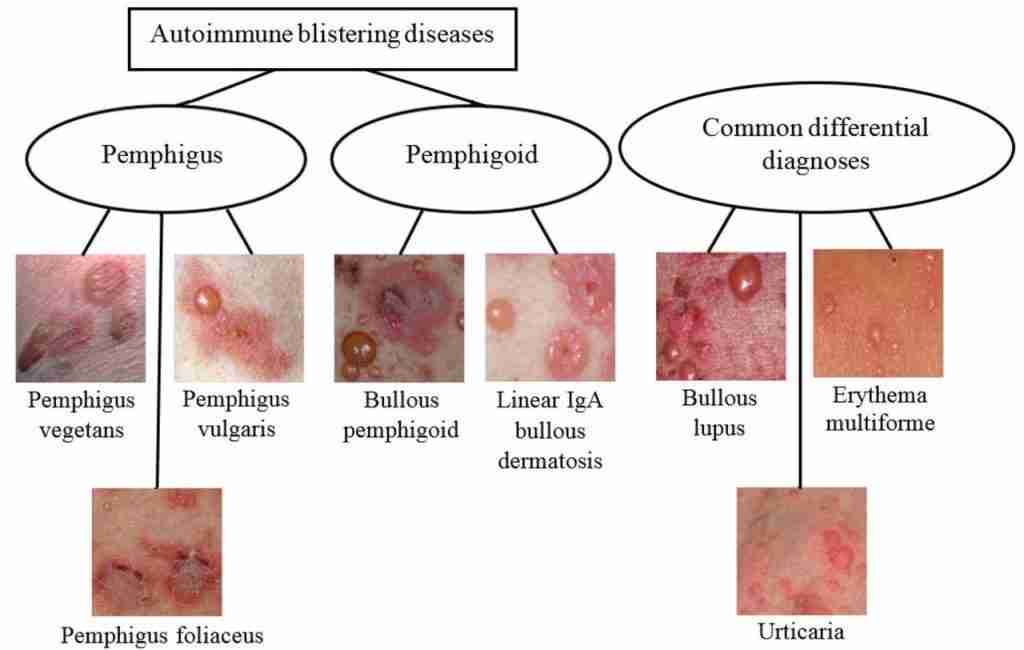

Clinical Presentation of Pemphigoid

Clinical Presentation of Pemphigus
Blistering Disorders Treatments
1 – Topical Corticosteroids
Topical corticosteroids are commonly prescribed to treat blistering disorders by reducing inflammation and preventing new blisters from forming. These medications are applied directly to the affected areas of the skin. Potent corticosteroids are often used in conditions like bullous pemphigoid to manage localized outbreaks and provide relief.
2 – Systemic Corticosteroids
For more severe or widespread cases of blistering disorders, oral corticosteroids like prednisone may be prescribed. These medications help reduce inflammation throughout the body, suppress the immune system, and control blister formation. Systemic corticosteroids are typically used in conjunction with other therapies for conditions like pemphigus vulgaris.
3 – Immunosuppressive Drugs
Immunosuppressive drugs, such as azathioprine, methotrexate, or mycophenolate mofetil, are used to suppress the overactive immune response that causes blister formation. These medications help to prevent new blisters from developing and are often used alongside corticosteroids to lower the required dose and reduce side effects.
4 – Intravenous Immunoglobulin (IVIG)
In severe or resistant cases of blistering disorders, intravenous immunoglobulin (IVIG) may be used. IVIG therapy involves the infusion of healthy antibodies from blood donors to help regulate the immune system. It can be particularly effective in cases of pemphigus vulgaris and other autoimmune blistering disorders that do not respond to other treatments.
5 – Rituximab
Rituximab, a monoclonal antibody, is sometimes used in the treatment of severe autoimmune blistering disorders like pemphigus vulgaris. It works by targeting and depleting the B cells that produce antibodies responsible for blister formation. Rituximab can be particularly helpful for patients who do not respond to conventional therapies.