- Home
- About Us
- Connect
- Patient Resources
- Anesthesia / Sedation / Pain
- Patient Instructions/After Care
- Patient Intake Forms
- Patient Consent Forms
- Office Policies
- Insurance Plans
- Financial Policies
- Privacy Policy
- Online Privacy Policy
- Mobile Message Terms
- Statement of Nondiscrimination
- Open Payments Database Notice
- Accessibility Statement
- Pet/Service Animal Policy
- Health Advisory
- Medical Dermatology
- Mohs/Reconstructive Surgery
- Facial Aesthetics
- Facial Aging 101
- Concerns
- Non Surgical
- Surgical
- Hair Loss
- Cosmetic Mole Removal
- Body Aesthetics
- Varicose Veins
- Scars
- Skin Care
- Wound Care
For Providers: Mohs Surgery Referral Form
What is Mohs Surgery?
Mohs surgery, named after its founder (Frederic Mohs), is a highly skilled and precise surgical technique for the removal of various types of head and neck skin cancers including basal cell carcinoma, squamous cell carcinoma and melanoma. This type of surgery can also be used to remove rare or high-risk skin cancers that occur on the trunk and extremities.
Mohs micrographic surgery offers the best chance for completely removing skin cancer while conserving as much healthy skin as possible. It uses microscopic guidance to decrease the likelihood of missing cancer cells not visible at the skin surface thus avoiding large incisions that unnecessarily remove healthy skin and result in bigger scars.
Mohs surgery offers those with skin cancer of the face, head or neck major advantages when undergoing this procedure including:
- Immediate notification that the cancer is completely removed
- The highest published cure rates for many forms of skin cancer, making it less likely that the cancer will recur
- Cancer recurrence rates in patients who have had Mohs surgery is less than 2 percent, while those who do not undergo this surgery have recurrence rates of more than 10 percent
- Maximum preservation of healthy skin for the best possible cosmetic and functional results
- In most cases, patients undergo the reconstruction portion of their surgery on the same day as diagnosis and have procedures performed by the same Mohs surgeon.
At Integrated Skin Institute, our Mohs and reconstructive surgeons are board-certified in both dermatology and Mohs micrographic surgery. They underwent a rigorous year-long fellowship training program under the guidance of veteran Mohs College surgeons who have demonstrated expertise in Mohs surgery and complex facial reconstruction. Our surgeons have extensive experience performing complex wound reconstruction and removing tumors in difficult locations and cosmetically sensitive areas such as the nose, ears, lips, and eyelids.
At Integrated Skin Institute, our state-of-the-art, CLIA-accredited Mohs surgery units are equipped with on-site laboratories that immediately process surgical specimens, allowing for real-time microscopic evaluation and immediate results to the patient.
Treatment Options for Skin Cancer
There are several methods of treating skin cancer, all of which are highly successful in the majority of patients. Which treatment we recommend depends on several factors, such as the location of the cancer, its size, its depth, its growth pattern, and previous therapies. Laser and topical treatments are not generally recommended as a skin cancer treatment except for certain forms of superficial cancer and precancerous growths
Aside from Mohs surgery, therapies include:
- Excision (non-Mohs surgical removal)
- Electrodessication and curettage (scraping with a curette then burning with an electric needle) - “scrape and burn”
- Radiation therapy
- Cryosurgery (freezing)
- Injectable chemotherapy

Why Mohs Surgery?
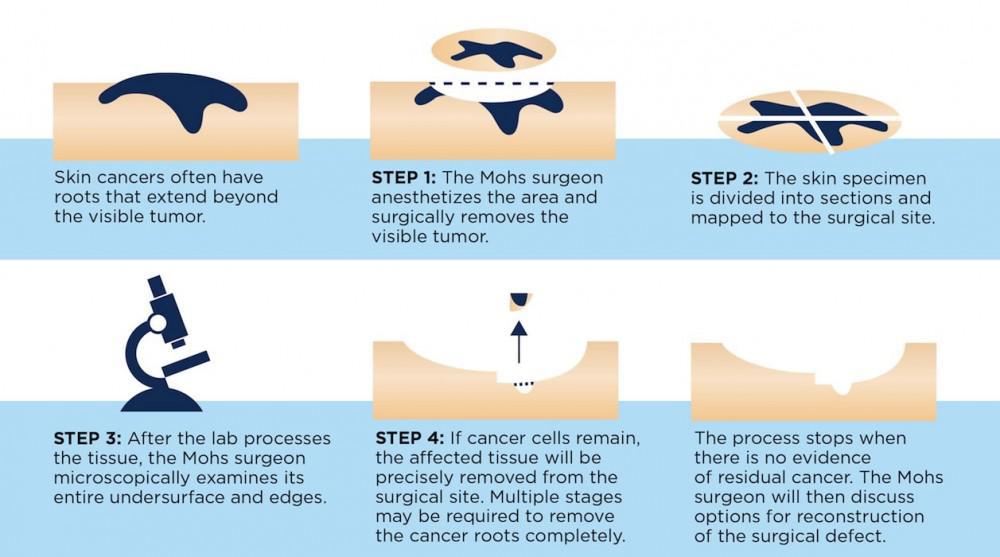
- In non-Mohs surgery (also known as wide local excision), only a sample of the cut surface (surgical margin) is examined under the microscope. The tissue is removed (Figure 1, left) and only one percent of the margin is actually examined in most cases.
- In Mohs surgery, nearly 100 percent of the margin is examined under the microscope (Figure 1, right) decreasing the risk that small areas of residual tumor will be missed.
Mohs micrographic surgery is a specialized type of surgery developed for the precise and complete removal of skin cancers. It has the following unique hallmarks:
- The entire cut surface (100% of the cancer margins) is examined under the microscope
- The same physician is both surgeon and pathologist. That is, the Mohs surgeon who removes your cancer also reviews the cut surface under the microscope and determines if cancer is still present (margin). If cancer is present, the Mohs surgeon knows exactly where the cancer is and removes more tissue precisely at that location
The precision of Mohs micrographic surgery results in two major advantages:
- The surgery has the highest published cure rates for skin cancer (98 percent for BCC and SCC), making it less likely for cancer to grow back
- The surgery provides maximal preservation of healthy skin, which leads to the best possible cosmetic and functional result
Mohs Surgery Procedure
Will Mohs Surgery Work for Everyone and Every Tumor?
We follow appropriate use guidelines for Mohs surgery, as we would for any treatment. In 2012, a study outlined the criteria for appropriate uses of Mohs surgery. This is an evolving document and will soon be updated. In general, Mohs is deemed appropriate for:
- Head and neck tumors
- Tumors on areas that needed tissue sparing such as the hands, feet, genitalia, and shins
- Tumors with an aggressive histologic appearance
- Tumors greater than two centimeters off the head and neck
- Tumors on immunosuppressed patients, including those with organ transplants, leukemias/lymphomas, autoimmune conditions, and on immunosuppressive medications
The decision to perform Mohs surgery is ultimately a decision between the patient and the clinician. These are major factors in considering Mohs surgery as the best treatment for a specific type of skin cancer.
What Types of Cancer Does Mohs Surgery Treat?
- Basal cell carcinoma
- Squamous cell carcinoma
- Melanoma
- Dermatofibrosarcoma protuberans
- Atypical fibroxanthoma
- Merkel cell carcinoma
- Microcystic adnexal carcinoma
- Sebaceous cell carcinoma
- Extramammary Paget disease
- Leiomyosarcoma
- Hidradenocarcinoma
- Trichilemmal carcinoma
- Mucinous carcinoma
- Porocarcinoma
- Eccrine carcinoma
Mohs surgery is a treatment option for certain stages of melanoma, particuarly for melanoma in situ, which is often found on the face, allows us to remove the minimal amount of tissue while even more effectively removing the tumor.
Reconstructive Surgery
Post-Mohs skin cancer reconstruction surgery restores both the look and function of your skin after Mohs surgery
The specific methods used for your Mohs reconstruction will vary depending on your unique circumstances and the wound defect (size, depth, location) after cancer removal.
Reconstruction may involve any one or a combination of the following options:
- Allow the wound to heal on its own
- Close the wound
- Linear closure (straight line)
- Skin Flap (movement of adjacent skin)
- Skin Graft (movement of distant skin)
- Structural grafting (i.e.- use of mucosa, cartilage)
The incision lines are often designed parallel to or within natural lines of the face to help conceal the resulting scars.
Depending on the extent of your skin trauma, post-Mohs reconstruction may be performed in multiple stages. If the Mohs defect involves an area of the nose, the repair may involve the use of cartilage grafts to maintain or improve the nasal airway. Sometimes the repair may require multiple revision surgeries to achieve the most natural appearing and aesthetically pleasing results
With a patient-centered approach, we tailor each reconstruction surgery to suit individual needs, while ensuring functional and aesthetically pleasing outcomes.
Healing from Mohs reconstructive surgery is a process that varies depending on the extent of the surgery. For patients with closures on the face, sutures are removed in five to seven days. Patients who needed a skin graft have their sutures removed within two weeks.
Follow-up care is essential – our team will provide appropriate wound care instructions and schedule follow-up visits as necessary to ensure optimal healing.